I went to a really interesting presentation at the National Sailing Academy in Portland today. It was about the 2012 Cultural Olympiad. That’s right CULTURE (the stuff that Purbeck District Council seems to think doesn’t exist). There was a whole chunk of the Olympic bid that was about cultural spin offs and as we have the only complete games venue and programme outside of the M25 it means that a large part of the Cultural Olympiad will be happening in Dorset. The Arts Council of England have produced a strategy and the Jurassic Coast Arts Strategy (remember that?) will be at its heart. Funds will begin to be allocated from next year. Interstingly enough, there will be special attention to international cultural exchanges and, for no apparent reason, the two selected countries will be Brazil and India. I think we’re already on to that, aren’t we?
Projects will be considered in categories according to whether they use existing resources, or new resources or exciting possibilities. At the moment everything is up for grabs and the County Arts Development Supremo Mike Hoskin is gathering suggestions. Nothing is ruled in and nothing is ruled out. So have a punt at some creative thinking.
Will it effect us in Purbeck and by how much? Well, to start with, the Olympic organising committee has to deliver 3 or 400 4star bedspaces. Currently there are about 70 in the area. The answer is that they will be providing a luxury cruise liner anchored in Portland Harbour as the competitor’s village but it also means that virtually every bed in Dorset will be required for spectators and hangers on. Dorset is going to be awash with visitors and we have to look at the cultural events that will keep them here. We don’t have the cathedrals and galleries that other venues have had. What are they going to do?
Isn’t it just a fortnight in 2012? In order to win its Olympic status the sailing academy has to run full scale test events in the years running up to 2012 and starting next year there will be a major international event every September. In addition the National sailing Academy is seen as the premier International training venue and there will be a year round influx of teams and spectators. And that will continue long after 2012.
Cynical? Why not? On the other hand the Olympics and the Cultural Olympiad will happen. It will happen in Dorset. There are some interesting websites showing how other communities have benefited (forget the stuff about Olympic venues standing empty and being a burden on the taxpayer - The National Sailing Academy is already built, paid for and functioning. And it’s a rather nice building). Perhaps we could put aside our natural cynicism until 2013 and have a bit of what’s going on.
I hope to have a fuller report of the meeting availabler later.
http://www.wpnsa.org.uk/
http://www.london2012.org/en/ (look for “our vision”)
Tuesday, September 26, 2006
Art at Durlston
Ali at the country park has asked me to ask you all to put your thinking caps on and come up with some ideas for next year. They have funding for a schools week and want art events. Strata's efforts last year were a great success and had 3000 visitors . Can this be bettered?
Keith
Keith
Monday, September 25, 2006
I Know You're Out There
Since putting a counter on the site I know that people are clicking on. If you have any arts event you want to publish in Swanage or Purbeck, please put it here. Similarly if you want to be on our circulation list leave your contact details. I don't include anyone who doesn't ask.
Saturday, September 23, 2006
The Incomer and The Land
Music Theatre Workshop Series -Peta Lily and Andrew Dickson
"Noises and Bodies"
Bridport Arts Centre
Sunday October 15th 2006 11.00 - 4.00 £5 including refreshments
Noises and Bodies brings together composer and musician Andrew Dickson with writer/director/performer Peta Lily to work with the group to discover what we can create with movement and voice combined in different ways.We will take as our inspiration people’s thoughts, feelings and stories about the land and the community. And discover how we might express some of the atmospheres and emotions involved in our relationship with each other and the land. We will be drawing on the wonderfully rich and varied material which has been collected so far through the ongoing interview process, which is one of the first steps of the Incomer and the Land Project. A lot of the stories already gathered speak of thedeep emotional connection between human beings and the land. You will be invited to contribute your stories to the body of research material in advance of the workshop day. This workshop is open to everyone –if it’s a success, there is a possibility of exploring the work further at a full weekend workshop in the spring. The workshop led by Peta will be physically undemanding and gentle in its explorations with Andrew encouraging singing that anyone can manage.
To book please contact Nichola Motley on email nichola.motley@tiscali.co.uk
or call 01308 422 305
http://www.operacircus.co.uk/
"Noises and Bodies"
Bridport Arts Centre
Sunday October 15th 2006 11.00 - 4.00 £5 including refreshments
Noises and Bodies brings together composer and musician Andrew Dickson with writer/director/performer Peta Lily to work with the group to discover what we can create with movement and voice combined in different ways.We will take as our inspiration people’s thoughts, feelings and stories about the land and the community. And discover how we might express some of the atmospheres and emotions involved in our relationship with each other and the land. We will be drawing on the wonderfully rich and varied material which has been collected so far through the ongoing interview process, which is one of the first steps of the Incomer and the Land Project. A lot of the stories already gathered speak of thedeep emotional connection between human beings and the land. You will be invited to contribute your stories to the body of research material in advance of the workshop day. This workshop is open to everyone –if it’s a success, there is a possibility of exploring the work further at a full weekend workshop in the spring. The workshop led by Peta will be physically undemanding and gentle in its explorations with Andrew encouraging singing that anyone can manage.
To book please contact Nichola Motley on email nichola.motley@tiscali.co.uk
or call 01308 422 305
http://www.operacircus.co.uk/
Moonlight and Music
Hello,
This is an unashamed self-plug for one of my rare performances nowadays - at the Moonlight Bistro on the evening of Friday October 13th. They have a varied menu that's really not expensive and you can book a table on 01929 475615. Why not get together with a few other members of Strata and give it a go?
Best Wishes to You All,
Steve Darrington
www.stevedarrington.com and click on 'Music' for my musical background
This is an unashamed self-plug for one of my rare performances nowadays - at the Moonlight Bistro on the evening of Friday October 13th. They have a varied menu that's really not expensive and you can book a table on 01929 475615. Why not get together with a few other members of Strata and give it a go?
Best Wishes to You All,
Steve Darrington
www.stevedarrington.com and click on 'Music' for my musical background
Wednesday, September 13, 2006
Artists in and around Swanage
Here is the current list of contacts. Please contact me via e.mail or via this site for updates and additions. If you’re not in the network how will you know what’s going on?
Paul Angel
Digital Photography
www.paulangel.co.uk
paul@paulangel.co.uk
01202 421080
Carlotta Barrow
Stone Carving, Painting
Waterside Studio,
Peveril Point,
Swanage,
Dorset, BH19 2AY.
Telephone: 01929 425967
Email: zooks@peveriledge.com
Freya Boyesen
Visual Artist
http://www.freyamboyesen.com/
freyahope@hotmail.com
Chris Burke
Artist
art@peveriledge.com
Gillian Bathe
Art /design teacher not resident but paints here.
Exhibition ' The Sea forChristmas' at Salisbury Library in December (all Purbeck Coastal subjects)
ionagbathe@btinternet.com
Carol Childs
Contemporary Artist
07709 492255
carol_iris36@hotmail.com
www.carolchilds.co.uk
Steve Darrington.
Musician and Swanage Blues Festival supremo
http://www.stevedarrington.com/ and
www.swanage-blues.org
01929 422338
s.darrington@btopenworld.com
Karen Delahay
Artist
studio/rehearsal/meetings space
artists friendly accommodation available.
www.californiacottage.co.uk
delahays@hotmail.com
F.L.A.M.E.
Fire, Light and Music Experience
smailto:Simon@flamefireshows.com -
07863 168447 (For bookings and questions)
www.flamefireshows.com/index.html
Richard Jeffery
photographer and 3D artist, webdesign
www.theeleventhhour.co.uk
http://www.creativecrows.co.uk/ is work from some of the groups I have worked with -mailto:-richard.jeffery@theeleventhhour.co.uk
Tony Kerins
Illustrator
www.tonykerins.com
84 Kings Road,
Swanage
Dorset BH19 1HR,
01929 425131
illustration@tonykerins.com
Denis Lowson
Artist
12c Institute Road,
Swanage
Dorset BH19 1BX
Ian Lowson
Writer
12a Institute Road
Swanage
Dorset BH19 1BX
ianlowson@hotmail.com
Sinead O'Neill
Artist
01929 426042
Jeremy Paul
Writer
01929 426688
www.jeremypaul.org.uk
jeremy@jpaulwriting.com
Purbeck String Festival
Susan Stanford - Artistic Director
Tel: 01929 426931
www.purbeckstringfest.com/welcome.html
purbeckstringfest@hotmail.co.uk
Quarr Gallery
Keith and Jane
17 High Street,
Swanage,
Dorset BH19 2LP
01929 423450
email quarr@operamail.com
Tara Randall
The Artist's Way Creative Cluster
randalls-4@tiscali.co.uk
http://strataartistsway.blogspot.com
The Ranger School of Dance
Dance and performance arts
01929 423436 / 01929 421510
http://www.rangerschoolofdance.co.uk/
info@rangerschoolofdance.co.uk
Shannon Ribbons
Off On One designs and produces websites, creates animations and makes pictures
www.offonone.com/
e-mail: mailto:info@offonone.com
phone: (01929) 424026
mobile: 07733361908
shannon@offonone.com
Ray Sargent
Actor, Musician
One Man Shows
www.ray-sargent.net/
01202 604598
ray@ray-sargent.net
Spyway Projects
Peter Cooper, Annette Sumption
38 Princess Road
Swanage
Dorset BH19 1JQ
01929 424428
www.spyway.co.uk
spyway@avnet.co.uk
Tidal Studios
Kate Cross
Design, print, promotion
01929 421535
www.tidalstudios.co.uk
kate@tidalstudios.co.uk
Tony Viney
leaves no stone unturned at
http://www.tonyviney.co.uk/ and at
www.boilerhousegallery.co.uk also at
www.purbeckfilm.com
tony@tonyviney.co.uk
Wendy Wharam
Artist, Writer, Story Teller
01929 426423
wendylallawharam@yahoo.com
Samantha Woodford
01929 421658
samanthawoodford@yahoo.co.uk
Sarah Wootton
Textile Artist
Toms Field Campsite.
Toms Field Road .
Langton Matravers.
Swanage. Dorset.
Tel 01929 427110
http://www.sewindorset.co.uk/
sarah@sewindorset.co.uk
Paul Angel
Digital Photography
www.paulangel.co.uk
paul@paulangel.co.uk
01202 421080
Carlotta Barrow
Stone Carving, Painting
Waterside Studio,
Peveril Point,
Swanage,
Dorset, BH19 2AY.
Telephone: 01929 425967
Email: zooks@peveriledge.com
Freya Boyesen
Visual Artist
http://www.freyamboyesen.com/
freyahope@hotmail.com
Chris Burke
Artist
art@peveriledge.com
Gillian Bathe
Art /design teacher not resident but paints here.
Exhibition ' The Sea forChristmas' at Salisbury Library in December (all Purbeck Coastal subjects)
ionagbathe@btinternet.com
Carol Childs
Contemporary Artist
07709 492255
carol_iris36@hotmail.com
www.carolchilds.co.uk
Steve Darrington.
Musician and Swanage Blues Festival supremo
http://www.stevedarrington.com/ and
www.swanage-blues.org
01929 422338
s.darrington@btopenworld.com
Karen Delahay
Artist
studio/rehearsal/meetings space
artists friendly accommodation available.
www.californiacottage.co.uk
delahays@hotmail.com
F.L.A.M.E.
Fire, Light and Music Experience
smailto:Simon@flamefireshows.com -
07863 168447 (For bookings and questions)
www.flamefireshows.com/index.html
Richard Jeffery
photographer and 3D artist, webdesign
www.theeleventhhour.co.uk
http://www.creativecrows.co.uk/ is work from some of the groups I have worked with -mailto:-richard.jeffery@theeleventhhour.co.uk
Tony Kerins
Illustrator
www.tonykerins.com
84 Kings Road,
Swanage
Dorset BH19 1HR,
01929 425131
illustration@tonykerins.com
Denis Lowson
Artist
12c Institute Road,
Swanage
Dorset BH19 1BX
Ian Lowson
Writer
12a Institute Road
Swanage
Dorset BH19 1BX
ianlowson@hotmail.com
Sinead O'Neill
Artist
01929 426042
Jeremy Paul
Writer
01929 426688
www.jeremypaul.org.uk
jeremy@jpaulwriting.com
Purbeck String Festival
Susan Stanford - Artistic Director
Tel: 01929 426931
www.purbeckstringfest.com/welcome.html
purbeckstringfest@hotmail.co.uk
Quarr Gallery
Keith and Jane
17 High Street,
Swanage,
Dorset BH19 2LP
01929 423450
email quarr@operamail.com
Tara Randall
The Artist's Way Creative Cluster
randalls-4@tiscali.co.uk
http://strataartistsway.blogspot.com
The Ranger School of Dance
Dance and performance arts
01929 423436 / 01929 421510
http://www.rangerschoolofdance.co.uk/
info@rangerschoolofdance.co.uk
Shannon Ribbons
Off On One designs and produces websites, creates animations and makes pictures
www.offonone.com/
e-mail: mailto:info@offonone.com
phone: (01929) 424026
mobile: 07733361908
shannon@offonone.com
Ray Sargent
Actor, Musician
One Man Shows
www.ray-sargent.net/
01202 604598
ray@ray-sargent.net
Spyway Projects
Peter Cooper, Annette Sumption
38 Princess Road
Swanage
Dorset BH19 1JQ
01929 424428
www.spyway.co.uk
spyway@avnet.co.uk
Tidal Studios
Kate Cross
Design, print, promotion
01929 421535
www.tidalstudios.co.uk
kate@tidalstudios.co.uk
Tony Viney
leaves no stone unturned at
http://www.tonyviney.co.uk/ and at
www.boilerhousegallery.co.uk also at
www.purbeckfilm.com
tony@tonyviney.co.uk
Wendy Wharam
Artist, Writer, Story Teller
01929 426423
wendylallawharam@yahoo.com
Samantha Woodford
01929 421658
samanthawoodford@yahoo.co.uk
Sarah Wootton
Textile Artist
Toms Field Campsite.
Toms Field Road .
Langton Matravers.
Swanage. Dorset.
Tel 01929 427110
http://www.sewindorset.co.uk/
sarah@sewindorset.co.uk
Contacts for Artists
After last week’s Strata meeting I thought it might be a good idea to circulate contacts for everybody. Why don’t you send me your website and contact details and I’ll e.mail them round. I will also start a list on my this site until we get the Strata website up and running. For obvious reasons, I won’t include anyone who doesn’t actually contact me to OK it. I am on several arts groups and mailing lists and I do hear about interesting opportunities so if you to hear about them as well then contact me.
Monday, September 11, 2006
Other Organisations are seeking us out
It's good to see that other organisations are linking to Strata. Keep your eyes open for opportunities that might be suitable for other group members and pass them on.
Here is one to be going on with:
Arts & Health South West - Artist Commission
EXTENSION TO DEADLINE
Arts & Health South West are looking to commission an artist for a print or series of prints that will be given to our Patron Members (key regional organisations including Arts Organisations, NHS Trusts, Council’s etc.).
What is required:A print or series of prints (max 3), these could be new or existing(edition of 10). The work must however be appropriate for healthcare organisations/settings.
Fee:£1k plus 1 years membership to A&HSW.
Deadline:10th November.Shortlisting:21st November.
Please provide:What form the commission will take (could be photography)
The size(s)
An indication of the theme
Why you think you are relevant for the commission inc cv
Samples of other work preferably Jpeg format
Please send to:Emma Williams,
Co-ordinatorArts & Health South West
12 Sandbed Road
St Werburghs
Bristol BS2 9TX
T: 0117 907 3861 or e: info@ahsw.org.uk
Here is one to be going on with:
Arts & Health South West - Artist Commission
EXTENSION TO DEADLINE
Arts & Health South West are looking to commission an artist for a print or series of prints that will be given to our Patron Members (key regional organisations including Arts Organisations, NHS Trusts, Council’s etc.).
What is required:A print or series of prints (max 3), these could be new or existing(edition of 10). The work must however be appropriate for healthcare organisations/settings.
Fee:£1k plus 1 years membership to A&HSW.
Deadline:10th November.Shortlisting:21st November.
Please provide:What form the commission will take (could be photography)
The size(s)
An indication of the theme
Why you think you are relevant for the commission inc cv
Samples of other work preferably Jpeg format
Please send to:Emma Williams,
Co-ordinatorArts & Health South West
12 Sandbed Road
St Werburghs
Bristol BS2 9TX
T: 0117 907 3861 or e: info@ahsw.org.uk
Sunday, September 10, 2006
To Build or Not to Build
Recently we have spent a lot of time worrying about a new Arts centre for Swanage. We desperately need a small performance space where people like me can harangue small captive audiences with our poetry, or where a string quartet could rehearse. We need some decent exhibition space, we need workrooms for electronic and other artists. When it opens, I shall be first in line for the champagne reception. But who builds it, has their name on the front, or where the funding comes from, I don’t care very much. Or even if it doesn’t get built at all, come to that. In fact the likelihood of it not being built is as predictable as winter following autumn. So why worry?
What happened to the original idea of Strata as an arts Centre without a building? The most important function of an organisation like ours is to help artists to produce art. To encourage and develop festivals and events. To help people discover their own creativity. To tap into those funding streams for the arts that the town has been missing out on. Yes, most towns do those things from a building or an institution. But we have no such building based organisation or institution with a brief to develop the arts. Our district and town councils see no value in the arts. And, any way, there are plenty of examples of arts buildings which have cost so much that there is nothing left to fund a programme inside. There are even buildings where the management committees have to put all their efforts into keeping the fabric together leaving no time to put a programme at all. It requires us, the artists of Purbeck and Swanage, to be more imaginative. We have to make use of the churches and halls and pub back rooms that are here. We must be bold and creative. We must develop our bona fides with the funding bodies by producing paintings, music, performances of such quality and innovation that we have the honest citizens town out on the streets with placards demanding that somebody builds a building to put it in.
Until then... let’s just think about what we do best... making art.
What happened to the original idea of Strata as an arts Centre without a building? The most important function of an organisation like ours is to help artists to produce art. To encourage and develop festivals and events. To help people discover their own creativity. To tap into those funding streams for the arts that the town has been missing out on. Yes, most towns do those things from a building or an institution. But we have no such building based organisation or institution with a brief to develop the arts. Our district and town councils see no value in the arts. And, any way, there are plenty of examples of arts buildings which have cost so much that there is nothing left to fund a programme inside. There are even buildings where the management committees have to put all their efforts into keeping the fabric together leaving no time to put a programme at all. It requires us, the artists of Purbeck and Swanage, to be more imaginative. We have to make use of the churches and halls and pub back rooms that are here. We must be bold and creative. We must develop our bona fides with the funding bodies by producing paintings, music, performances of such quality and innovation that we have the honest citizens town out on the streets with placards demanding that somebody builds a building to put it in.
Until then... let’s just think about what we do best... making art.
Saturday, September 09, 2006
Friday, September 08, 2006
Impasto Gusto
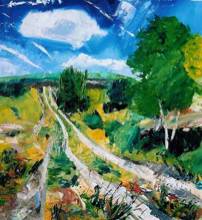
I was bowled over by a twin site exhibition at the Quarr Gallery and at the Rectory Classroom in Swanage. The painter was Stephen Bishop and the exhibition was called "Images of a Purbeck Summer". Normally, I think I would have given an event with such a title a bit of a miss; I think I've seen just about all the views of Old Harry and Studland beach that I care to see. But this was something different. These paintings were, indeed, of the iconic views but they were painted with such energy and commitment that you couldn't but be rocked backwards by the effect. The paint was thick and layered from bright greens and blues and purples. The horizons slanted and swayed. It looked as though the artist was attacking the Purbeck landscape. A whole room full of these works and you really got something from the place that is usually missed by the chocolate box painters. You got a sense of the underlying force of nature, the oppressive summer heat of the heath, the cutting wind, the angry waves. The picture for me was of a single heathland tree, angled by the wind standing in a sea of gorse and heather with a brilliant blue streak of hills in the distant background. If anyone wanted an image of Hardy's Egdon Heath. This was it.
Astonishingly, Stephen Bishop is a warm, friendly person; happy to talk about his work. Not precious at all. And, incredibly, the paintings are made en plein air. He sets up his easel and he gets the paint and sand and anything else adjacent onto the canvas until he's finished and then he stops.
Congratulations Stephen Bishop and also Keith and Jane at Quarr gallery for letting us see this fantastic display.

Monday, August 28, 2006
Strata
I published this on Swange View Blog but thought it might be informative to copy it here as an update on our work. As you see, we have now become Strata and already have a number of interesting projects in the pipeline. Watch this space.
"I feel it might be useful to give a little more detail about Strata. As an Arts professional I have attended meetings about funding the Arts in Dorset for the last fifteen years and I have seen public funding rise in all areas of the County except for Purbeck. The reason is quite simple. In all other districts there are organisations that lead the bidding process for funds. The Bridport Arts Centre and other organisations funnel quite significant streams of money into West Dorset. There are similar organisations in North, East and the towns and conurbations. These are responsible for making use of Lottery, Arts Council and foundation funding to promote theatre, exhibitions, events, arts education in their buildings and into the surrounding areas. There is no such organisation in Purbeck and, consequently, over the years significant sums of money have passed us by. This money is not anything we do not deserve. We have already paid for it by buying our lottery tickets or donating to cultural charities. There is even a fraction of a penny in the general taxation we pay. The last straw as far as I was concerned was the Purbeck District Cultural Strategy which made barely a mention of the arts and the Jurassic Coast Arts Initiative where large sums of money will end up in Charmouth and Lyme Regis (good luck to them) and probably none in Swanage.So in February we started the long process of setting up an organisation to channel our money back to Purbeck. We decided early on that it would be an organisation led by artists and all those interested in developments in the arts. The membership is wide and growing, painters, sculptors, writers, theatre people, dancers, photographers and more. We hope to include anyone in the creative industries, chefs, gallery owners, theatre managers, designers, architects. In June we rolled up a functioning group of visual artists and we have taken their name - Strata - and thus it was that we had our first event - an exhibition at Durlston castle for Dorset Art Weeks. Plans are already afoot for some fascinating events next year. Meanwhile we are on the point of completing the necessary instrument to become a charitable company. And the real work can begin. As soon as we have the company in place we will have a public launch to which we can invite the great and the good and the general public. We hope that our website with a database of functioning Purbeck artists will be on line in the very near future.If you are an artist of any sort or are interested in the future of the arts come along to our meetings (First Wednesday every month at Quarr Gallery, High Street, Swanage at 7.30pm and other social occasions) or contact us via Quarr Gallery."
"I feel it might be useful to give a little more detail about Strata. As an Arts professional I have attended meetings about funding the Arts in Dorset for the last fifteen years and I have seen public funding rise in all areas of the County except for Purbeck. The reason is quite simple. In all other districts there are organisations that lead the bidding process for funds. The Bridport Arts Centre and other organisations funnel quite significant streams of money into West Dorset. There are similar organisations in North, East and the towns and conurbations. These are responsible for making use of Lottery, Arts Council and foundation funding to promote theatre, exhibitions, events, arts education in their buildings and into the surrounding areas. There is no such organisation in Purbeck and, consequently, over the years significant sums of money have passed us by. This money is not anything we do not deserve. We have already paid for it by buying our lottery tickets or donating to cultural charities. There is even a fraction of a penny in the general taxation we pay. The last straw as far as I was concerned was the Purbeck District Cultural Strategy which made barely a mention of the arts and the Jurassic Coast Arts Initiative where large sums of money will end up in Charmouth and Lyme Regis (good luck to them) and probably none in Swanage.So in February we started the long process of setting up an organisation to channel our money back to Purbeck. We decided early on that it would be an organisation led by artists and all those interested in developments in the arts. The membership is wide and growing, painters, sculptors, writers, theatre people, dancers, photographers and more. We hope to include anyone in the creative industries, chefs, gallery owners, theatre managers, designers, architects. In June we rolled up a functioning group of visual artists and we have taken their name - Strata - and thus it was that we had our first event - an exhibition at Durlston castle for Dorset Art Weeks. Plans are already afoot for some fascinating events next year. Meanwhile we are on the point of completing the necessary instrument to become a charitable company. And the real work can begin. As soon as we have the company in place we will have a public launch to which we can invite the great and the good and the general public. We hope that our website with a database of functioning Purbeck artists will be on line in the very near future.If you are an artist of any sort or are interested in the future of the arts come along to our meetings (First Wednesday every month at Quarr Gallery, High Street, Swanage at 7.30pm and other social occasions) or contact us via Quarr Gallery."
Thursday, April 06, 2006
Creative Purbeck
I was astonished with the turnout at our third meeting last night. People brought wine and beer along and there was a much more social feel to the proceedings. Everybody was very forthcoming and ideas were kicked around in a useful way. I'm sure we will get a more formal record elsewhere but I thought I'd make a note of the fact that I came away more hopeful than after the March meeting. There was a real keenness to get the organisation up and running so that we could start Doing things. Keith Roker has registered the website name creativepurbeck.com . I'm happy with that although it wouldn't have been my choice initially. I hope we can begin getting stuff onto the site so that we can prove we have an existence. Once we have a formal structure we can invite some of the great and the good to participate in what we're doing but it's important that we build our confidence so that we're not swamped by other interests. Nick Goulding has been guiding the meetings in his quiet but determined way and he might be persuaded to take the role of Chair once we get up and running.
I keep going to arts funding events where there is a general level of pity for the low funding levels for the arts in Dorset and in Purbeck in particular. I believe we could make some inroads into that if we have a close network of artists who want to make a difference. We just need to start sending out the applications until the funders' filing cabinets are stuffed full of files from Creative Purbeck. So we need ideas for projects and leaders to push them forward.
I keep going to arts funding events where there is a general level of pity for the low funding levels for the arts in Dorset and in Purbeck in particular. I believe we could make some inroads into that if we have a close network of artists who want to make a difference. We just need to start sending out the applications until the funders' filing cabinets are stuffed full of files from Creative Purbeck. So we need ideas for projects and leaders to push them forward.
Thursday, February 16, 2006
What happened when we got together
The meeting attracted about 20 people from a variety of art fields. It was a very open and informal meeting and not one which was conducive to producing detailed minutes.Although it was generally felt that the town needs some form of organisation for the arts there are a number of views on the form this should take without duplicating what is already here, for example the Arts Club. Some people felt that regular informal gatherings for networking and the exchange of information and ideas would be worth having. A web site and a regular newsletter were suggested and supported. The possibility of establishing and marketing a Purbeck arts brand was raised and the context of arts in the area in general were discussed, although it was clear that progress on this would involve setting up some form of organisation.It was agreed to have another meeting on Tuesday 2 March at 7.30 at the same venue to carry matters on.This will look at would would be entailed in establishing a more formal organisation for which the following detailed objectives have been suggested:"We will deliver workshops, masterclasses and other learning events for practising and aspiring artists. We will seek to fund commissions for new work and actively promote commissions from other organisations and agencies. We will review and, where possible, provide resources and facilities for learning about the arts and for acquiring art skills for children, young people and adults who otherwise would not have access to such facilities. We will offer a marketing resource for practising artists in swanage and Purbeck, creating a Purbeck Arts Brand or similar umbrella resource. To further this end we will work with established agencies such as South West Arts Marketing. We will encourage the awareness of the arts in Swanage through prizes, competitions, exhibitions and other events. We will work with such agencies as are available to deliver these or we will instigate and run our own events where no partner agency or organisation is available. To achieve this we will employ any such staff as might be neccessary. We will act as a support agency and clearing house for artists applications to grant giving bodies. We will help development of personal, business and marketing skills for artists and would support an artists’ mentoring scheme such as that run by The Arts Matrix."
Wednesday, January 25, 2006
Meeting for Swanage Artists
For some time now we have been grumbling about various arts and cultural issues in Swanage. We all know that there is a considerable amount of public funding that Swanage has missed out on, we also know that there are serious problems with lack of studio and workshop space. We all saw the contempt that PDC treated us with when they produced their Cultural Strategy. Well, nothing’s going to happen on its own so I’m proposing setting up an Arts development Organisation in Swanage that will help promote the arts within the community, develop new funding opportunities and help in the education and training of young and aspiring artists. Back in the autumn there was a terrific turnout of Arts practitioners and interested parties to the Jurassic Coast Arts meeting. Let’s capitalise on that and get together. I’m suggesting a meeting on Wednesday 8th February at the Quarr gallery 17 High Street Swanage at 7.30. If necessary, we’ll move on to a suitable hostelry. The meeting is open to all practising artists (that is musicians, writers, sculptors, actors, performance artists, dancers, painters, photographers) and anyone else interested in developing the Arts in Swanage for the 21st Century. If we can organise ourselves into some sort of recognisable body we will hold a larger meeting in a couple of months to which we can invite the Great and the Good.
Saturday, September 03, 2005
The Final Version
Sticks and Stones and Serious Thought
A Swanage perspective on the Cultural Strategy
However there are four main areas of contention:
1) We cannot agree with the narrowness of the strategy's definition of culture or with the parochial scope of the strategy itself. It does not accord with any known definition of culture and even falls short of the government’s own guidelines.
2) Consequently The strategy shows every sign of having been constructed backwards, as it were, with the aim of supporting and justifying particular existing medium term local objectives of PDC, without trying to come to grips with new ideas and thinking.
3) We consider that the strategy needs to be related to both PDC's vision statement and the policies of other public bodies. PDC was criticised last year for not identifying the means through which its vision is to be delivered. This strategy offers an opportunity to come to grips with this issue.
4) There needs to be attention to the economic value of culture and the relevance of tourism
1) SOME DEFINITIONS
The OED defines culture as.... "The training and refinement of mind, tastes and manners....... the intellectual side of civilization.” Anthropologists would say culture is .. "the combined understanding of a single group of people in contrast to any other.” In both cases it is to do with ideas, stories, arts. It ranges through architecture, scientific enquiry, spiritual enquiry and learning to barn dances and conversations at bus stops. It is the appreciation of the natural environment we live in and also an attempt to enrich that appreciation through art and education. Culture is the software that joins us together in our communities. It helps us understand who we are, how we got here and where we are going.
None of these definitions includes sport, health, youth offending, footpaths or other subjects which, whilst important, worthy and necessary, do not form part to the essence of culture. However, these peripheral ideas do have a bearing on the “Quality of Life” and, as the government does include some of them in its own definitions, it is fair for PDC to make use of some Quality of Life issues in its wider definition of culture.
In a sense, any activity that entails social interaction or aesthetic appreciation could be seen as cultural: An evening in the pub, a village fete, a walk on the cliffs, but we need to focus on some core values.
At the same time, however, it is not acceptable to reduce the definition of culture to “Leisure Sports and Recreation”. These ideas are not included in the government’s definition at the expense of actual cultural activities. It is also clear that these side issues are only included insofar as they contribute to the cultural life of the community. In other words, a test needs to be applied to developments to see if they actually are reflecting or contributing to cultural life. We may ask of a sports facility “how does it enhance or reflect the cultural life of the community?” If the answer is “It will be a venue for a local choir to rehearse” or “It will provide a base for a literature festival or be used for Adult Education classes” then, yes, it is a cultural facility. If it only provides sports, health or fitness facilities, then it is not.
Undoubtedly culture is a leisure activity for most people, but, as we discuss below, culture is also a significant, indeed essential, part of Purbeck's economy. Culture needs to be recognised as being at the centre of economic development and not diminished to a tactic for getting kids off the streets.
2) CULTURAL LIFE IN PURBECK
Purbeck people may have a concept of their own culture as an old fishing, quarrying, farming community. And even as a tourist venue with a culture of service. But there are few opportunities to record, respond and challenge the ideas of what it is actually like to be part of Purbeck culture in the 21st century.
The various cultures of Purbeck are as diverse as any in rural Britain today. There is the culture of the elderly, the hard-pressed farmer, the foreign language students, the incomers, the builders and developers, the alienated youth and so on. Most people belong to more than one culture.
These diverse cultural strands means that it much more difficult to define a Purbeck sense of identity. Communities are fragmented. Many incomers feel a lack of ownership of the area. This also applies to young people for whom the idea of living and growing up in Swanage has an entirely negative air. It is inevitable that young people entering tertiary education will move away but, beyond that, there is a feeling that to stay in Swanage during into adulthood means inevitable brain death.
It is one of the key jobs of a cultural strategy to identify those cultural strands and make sure that they are reflected and enriched.
PDC’s own figure demonstrate that a far greater percentage of the population engages in cultural activities than attend or participate in, say, sporting activities. (and there are many more that are not included such as , tap dancing, line dancing and so on). These figures show that Purbeck people participate in the Arts and culture to a greater degree than the national average (According to the Arts Council of England 26% of population attended a general art event including carnivals, festivals and circuses in 2003/2004 25% went to the theatre, 26% attended a musical, 8% attended a cultural festival, 4% a dance event) Yet, mysteriously, Purbeck District Council does not have a great tradition for encouraging or supporting these activities within the district. Even the admirable Heritage Committee sees its role in supporting infrastructure rather than the heritage of ideas.
It seems clear that the majority of culture consumers travel out of the area. This means, not only a loss of income, but an inevitable feeling that Purbeck has no culture of its own and its various cultures are not reflected to its inhabitants.
There is a range of small community venues that are able to act as centres of cultural activity (there is a strong tradition of music making and performing in churches, the schools provide facilities for adult classes, the village halls are venues for dances and occasional theatre performances ) These activities are small and ad hoc and there is no mechanism or facility for encouraging artistic or creative activity within those buildings. The Mowlem, originally set up as an institute and reading room, is restricted by its Trust to the provision of a hall and a meeting room. In order to comply with the conditions of its Trust it has no means to support creative and arts initiatives. It does a good job as The Village Hall for Swanage but it cannot achieve more.
There is a strong tradition of amateur arts activity which, while performed with commitment and enthusiasm is not able to take on new challenges or raise its game to new standards. They tend, as membership groups , not to have the resources or structures to include younger members of the community. It might be worthwhile to make a resource available to amateur groups and individuals that would enable them to take on new challenges. At the same time, there is no local professional organisation with a cultural brief that can access and direct funding into the area. This has resulted in the sorry position that Purbeck has been unable to access its share of Lottery and Arts Council monies over the years and is regarded by some as being a cultural lost cause.
So the cultural map is largely made up of culture seekers having to travel out of the district and of practitioners having to stumble on with little support.
3) SOME RESEARCH
The figures above show that Purbeck residents are a reasonably cultural aware community but the result of the small sample research seems to indicate the opposite.
Our interpretation is that the research asked the wrong questions. Of course people don’t expect “leisure, recreation and sport” to contribute to the local economy or to a sense of the local identity of Purbeck.
But These are exactly the two areas in which a cultural strategy should operate and should be addressed with utmost urgency.
It has been enlightening to compare other Districts’ Cultural Strategies. Two downloaded at random from the internet (West Berks and Aylesbury Vale) show quite different approaches. In both cases there is a strong history of support for the arts and culture in the past. Consequently their residents show a great deal more awareness of , not only what can be achieved through cultural activities but have higher demands for more.
4) CULTURE AND THE ECONOMY
While culture can be seen as a leisure activity for the majority of the population of Purbeck, it should not disguise the fact that, as defined by the government guidance, it forms the basis of the district’s economy and provides large numbers of jobs, either in direct delivery of cultural experiences or in the infrastructure of the tourist industry.
Try to imagine a tourist industry with no cultural aspect. Obviously no NationalTrust, Tank Museum, Monkey World or country parks. No appreciation of the countryside or environment. No Jurassic Coast. Only the most basic necessities bought in the shops. Not even a Punch and Judy show on the beach.
In an area where environmental considerations prevent large scale office orindustrial development economic growth is going to come from adding to the touristexperience. This is culture and needs to be at the centre of this strategy.
Two developments are likely to have a significant economic impact in Purbeck in a relatively short time. These are the Jurassic Coast Development and the 2012 Olympics. Large numbers of visitors, many from overseas, will be passing through Purbeck and many will be persuaded to stay and, perhaps, return. We should be looking carefully at ways to encourage these visitors and a cultural strategy should include these.
5) CULTURE AND TOURISM
It is inevitable that culture and tourism will go hand in hand. Most of the tourists coming here will have a cultural aim in mind (even if it is the expectation of seeing old fishermen with grizzled beards and tarry jumpers mending nets and singing sea shanties) The cultural life of a small sea-side town means peace and tranquillity to some, amusements and glitter to others. But it is extraordinary how little of the actual cultural life of the place is on show to the visitors. Farming interpretation centres such as Putlake and Farmer Palmers do a good job but Sunnydown and its Dinosaur Footprint exhibition did not survive. The Ginger Pop Shop and related Enid Blyton walks and books show what can be achieved on the small scale. There are indeed, small museums in Corfe, Langton and Swanage and the prospect of some sort of interpretation centre at Durlston as well as the heritage and tourist centres but there is no feature that can provide the sort of cultural highlight for the main tourist areas in the way that the Tank Museum and Monkey World can do in the North.
The Festivals and carnivals are high points of the year but mostly occur during the summer months and there is a general awareness that there needs to be events happening in the shoulder periods. However, festivals cannot be just dreamt up and then expected to happen. Festival organisers spend vast amounts of time and, often, their own money to make these happen. They do this because they are committed to a particular idea and will sacrifice anything over long periods of time to make it happen. A District Council can never recreate this but it can support. A cultural advisory group, for instance, can sniff out the committed groups and individuals and give them encouragement and show them where to apply for funds. The District Council should not be afraid to put small amounts of seedcorn funding in to kick start some of the new enterprises. Not all will succeed but one success is a success.
In other words in an area so dependent on tourism we must take account of the cultural aspirations of visitors and follow up the good work that has been done in the past on making Swanage an attractive destination with providing good cultural venues and experiences.
Tourist policy at regional and County level emphasises the importance of providing an enriched and extended cultural experience for tourists which goes beyond the traditional "summer holiday" of previous generations. These policiesstress the role of "eco" or cultural tourism and very much revolve around the second definition quoted above. We consider that the strategy needs to relate to thesepolicies and the Jurassic Coast Arts policy and identify the role of PDC indelivering and enabling these within the district. We think that a cultural strategyfor an area with a tourism and environmentally based economy must therefore be a strategy for culturally based economic development in order to generate the wealth to provide for the leisure and sports needs, among others, of the local population.
In short, it’s the environment which brings visitors to Purbeck but it’s cultural activities which enrich the experience and bring in the money over and above the infrastructure of accommodation, car parking and fast food.
6) CULTURE AND THE COMMUNITY
One of the objectives of any strategy should be making available cultural experiences to communities that live here. At the same time it should be reflecting the cultural activities that exist here to other communities in Purbeck and outwards to the wider world.
There are few opportunities for cultural interchange. One of the ways in which culture is propagated is through critical mass. This is when individuals and communities are close enough together for a particular idea to take off and become amplified. Such “hot spots” have occurred with painters in St. Ives and Newlyn in Cornwall, for instance. (Interestingly, this is a homegrown Dorset idea with the development of the idea of “Community Plays” by Ann Jellicoe) In Purbeck, one of the cultural problems is the physical separation of rural communities and their fragmentation in towns. PDC could encourage one of these Hot Spots , a centre of excellence for a particular arts activity, whereby local amateurs, young learners and older beginners could come together with professionals to share interests and ideas. An ideal area for this could be in sculpture which has a natural fit and, indeed a proud history in Purbeck. PDC could encourage a tie up with a local quarry, seek out space for a sculpture park and offer micro workshop space. Local hoteliers might be encouraged to wade in with sculpture weekend breaks. There are many other areas where PDC could be proactive in promoting cultural hotspots without the cost of anything more than the time of a culture and arts officer.
Nobody expects PDC to have the resources or expertise to generate cultural programmes itself but there is no reason why it should not use its offices to promote and support this sort of activity. Our suggestion is that PDC encourages the setting up of a cultural steering group along the same lines as the heritage committee with the brief to explore a proper definition of culture as it applies to Purbeck and to advise PDC on possible cultural developments.
7) CULTURE AND YOUNG PEOPLE
In a community designed around the established and the comfortable it is inevitable that freewheeling youngsters are going to be seen as the enemy. The reaction to this has been two fold. Containment on the one hand and diversion on the other - ASBOs and skateparks.
Young people need more out of a community than this. They need challenges and some acknowledgement of their quest for identity.
It is a goal that most communities have failed to achieve, but because others have failed doesn’t mean that we cannot succeed in Swanage. We should look towards localised opportunities to encourage music, dance, drama for young people by young people - not as a diversion but as a genuine attempt to foster self confidence, self awareness and a feeling of self worth.
Having said which, there is no reason to suppose that this approach to Young People will not provide similar or better outcomes to the problems caused by alienation and dislocation from the wider community than a sporting diversion.
8) SWANAGE AND WORLD CULTURE
Swanage is unusual in its links with other parts of the world. It has a seafaring history . During the war, there was a great concentration of American and other foreign troops in the area and since then there have been cultural ties with large parts of the world through its language schools and other international education establishments. There is an active town twinning partnership which has seen real cultural exchanges.
As far as we know there is no research on the numbers of foreign tourists in Swanage but anecdotal evidence shows that they are increasing significantly. The Jurassic Coast Project and the 2012 Olympics will have a significant impact on these numbers . These new visitors will, generally, be better off than the traditional bucket and spade family and, more importantly, will be culturally aware. Unless we can persuade them otherwise, the trip to Swanage will be a brief stop-off at Durlston and on to Ann Hathaway's Cottage. It is unlikely that bedspace will be increased enough to make Swanage a longer stop but Swanage should be able to picture itself, for once, as centre of a world culture. and be able to persuade visitors to return for longer periods. It behoves us to be able to tell the story of Purbeck in a coherent way and to satisfy this potential for cultural tourism.
For some, we are already part of a world culture with the growing number of Swanage based websites. A cultural group ought to examine the effect of the internet and the world wide cultures to which Swanage people belong. Some acknowledgement ought to be given to those individuals who are making Swanage the hub of many of these interest groups and the support that can be given to them. It is essential that PDC is aware that potential visitors from around the world are learning about Purbeck from these websites and there is real potential for businesses to be based in Swanage with a world-wide clientele
9) CULTURE OF THE BUILT ENVIRONMENT
Although there has been an attempt to protect the general townscape there has been no attempt to encourage inspirational development of significant buildings. It was with some shock that residents realised that the only Victorian secular building of any size and historical significance (Seacourt) was about to be developed with no other considerations apart from sitelines and access. The cultural perspective of development needs to be addressed quickly. The importance of the few development sites available needs careful consideration. The cultural significance of the Commercial Road footprint and Pierhead needs direct intervention. It should be a planning requirement that cultural significance should be assessed at the planning stage. There is no reason why the District cannot expect a higher level of architecture and the inclusion of public art in planning developments.
10) HOW CULTURE WORKS
We mentioned earlier that there needs to be a test for cultural value. But there is not a distinction between life and cultural life. They are one and the same thing. Our Culture influences what we do and the world around us influences our cultural life. However whilst developing a cultural strategy there is no point in trying to justify culture in terms of other activities or in hiding other topics under the banner of culture. Culture has its own worth and must be looked at for the benefits it provides in itself.
The provision or signposting of a footpath, for example, is not a cultural development. The naming or describing the story of that footpath is. So that, whilst a footpath was being improved it could provide the opportunity for an artist to contribute to the waymarking. Posts or tablets could demonstrate “this path was originally used by quarrymen walking to work.” This will underline and preserve the cultural significance of the path for future generations. What about extending the idea to a network of cultural trails “The Priest’s Way” “The Spy Way” and so on.
Culture should be seen as an enrichment of the world as it is given to us.
11) A CULTURAL STRATEGY
PDC can use its cultural strategy to provide a direction for the practical realisation of its vision for the District : "Thriving communities in balance with the naturalenvironment."
The body of the PDC document makes quite clear that cultural activities are vital for the well-being of Purbeck. The conclusions are, unfortunately, skewed by its emphasis on Sports activities. While there are clear cultural links, they should, rather be removed to a separate “Sports, Health and Fitness” document. It appears that the Cultural Strategy is being used to hide other, non-related, activities. This leaves an extraordinary thin strategy for culture. However we can now flesh this out with some concrete suggestions:
12) RECOMMENDATIONS
Remove the aims “Sport, health and Fitness” from the thinking of the strategy and include in its own document
Set up Cultural advisory group to develop a proper definition of culture for Purbeck
Eventually employ a culture and arts officer.
This group can advise on:
Identification of some of the cultural strands of the District
Development of economic understanding of the need for culture particularly in tourism
Youth culture needs
The implications of Jurassic Coast Project and 2012 Olympics
Interaction with world cultures
This can lead to:
Sponsorship of a fund for arts innovations and projects
Including, for instance:
Facilities for music making (recording studio, practice rooms.)
Development of music teaching and mentoring network in the area.
Rehearsal and studio facilities for local performers
Promotion budget to encourage non-profit making performances
Encourage local organisations to take youth activities more seriously
Art gallery space
Development of other cultural festivals (literature, art, dance) with particular Purbeck themes.
At the same time PDC can:
Encourage one of the Dorset or regional arts organisations to relocate to Purbeck
Encourage the development of a cultural critical mass
Encourage a Sculpture hot spot including sculpture park, micro workshops for craftspeople
Include Interpretive waymarking for footpath network
Look for cultural significance in planning applications
Include Public art in new building developments
Develop a Sponsorship schemes to attract practitioners into the area.
It also needs to remember that:
Cultural activities do not need to be justified by unrelated labels and should not be used to hide non cultural activities however worthy.
Tuesday, August 23, 2005
Try This For Size
We applaud PDC for its document “Castles, Carnivals, Coast, Heath and Peoples” and its attempt to describe the culture in Purbeck. It does, however, draw some extraordinary conclusions which are at odds with its broad sweep. The main conclusion - support for a sports centre in Swanage - is admirable and necessary but detracts from the overall aim of producing a cultural strategy. This is not meant to be a rebuttal of the PDC document but, rather, aims to provide some ideas and positive thinking to flesh out a rather limited range of ideas.
However there are four main areas of contention:
1) We cannot agree with the narrowness of the strategy's definition of culture or with the parochial scope of the strategy itself. It does not accord with any known definition of culture and even falls short of the government’s own guidelines.
2) Consequently The strategy shows every sign of having been constructed backwards as it were with the aim of supporting and justifying particular existing medium term local objectives of PDC, without trying to come to grips with new ideas and thinking.
3) We consider that the strategy needs to be related to both PDC's vision statement and the policies of other public bodies. PDC was criticised last year for not identifying the means through which its vision is to be delivered. This strategy offers an opportunity to come to grips with this issue.
4) There needs to be attention to the economic value of culture and the relevance of tourism
SOME DEFINITIONS
The OED defines culture as.... "The training and refinement of mind, tastes and manners....... the intellectual side of civilization.” Anthropologists would say culture is .. "the combined understanding of a single group of people in contrast to any other.” In both cases it is to do with ideas, stories, arts. Culture is the software that joins us together in our communities. It helps us understand who we are, how we got here and where we are going.
Neither of these definitions includes sport, health, youth offending, footpaths or other subjects which, whilst important, worthy and necessary do not form part to the overall definition of culture. However they do have a bearing on the “Quality of Life and, as the government does include some of these peripherals in its own definitions, it is fair for PDC to make use of them in its wider definition.
But it is not acceptable to reduce the definition of culture to “Leisure Sports and Recreation”. These Quality of Life issues are not included in the government’s definition at the expense of actual cultural activities. It is also clear that these side issues are only included insofar as they contribute to the cultural life of the community. In other words, a test needs to be applied to developments to see if they actually are reflecting or contributing to cultural life. We may ask of a sports facility “how does it enhance or reflect the cultural life of the community?” If the answer is “It will be a venue for a local choir to rehearse” or “It will provide a base for a literature festival or be used for Adult Education classes” then, yes, it is a cultural facility. If it only provides sports, health or fitness facilities, then it is not.
Undoubtedly culture it is a leisure activity for those who may be describedas its "consumers", however, as we discuss below, culture is also a significant, indeed essential, part of Purbeck's economy and so does not fall to be dealt with simply as a form of service delivered or enabled by the council. Culture needs to be recognised as being at the centre of economic development and not diminished to a tactic for getting kids off the streets.
CULTURAL LIFE IN PURBECK
Purbeck people have a concept of their own culture as an old fishing, quarrying, farming community. And even as a tourist venue with a culture of service. But there are few opportunities to record, respond and challenge the ideas of what it is like to be part of Purbeck culture in the 21st century.
The various cultures of Purbeck are as diverse as any in rural Britain today. There is the culture of the elderly, the hard-pressed farmer, the foreign language students, the builders and developers, the alienated youth and so on.
These diverse cultural strands means that it much more difficult to define a Purbeck sense of identity. Many incomers feel a lack of ownership of the area. This particularly applies to young people for whom the idea of living and growing up in Swanage has an entirely negative air. It is inevitable that young people entering tertiary education will move away but there is a feeling that to stay in Swanage during your young adulthood means inevitable brain death.
PDC’s own figure demonstrate that a far greater percentage of the population engages in cultural activities than attend or participate in, say, sporting activities. (and there are many more that are not included such as , tap dancing, line dancing and so on). These figures show that Purbeck people participate in the Arts and culture to a greater degree than the national average (According to the Arts Council of England 26% of population attended a general art event including carnivals, festivals and circuses in 2003/2004 25% went to the theatre, 26% attended a musical, 8% attended a cultural festival, 4% a dance event) Yet, mysteriously, Purbeck District Council does not have a great tradition for encouraging or supporting these activities within the district. Even the admirable Heritage Committee sees its role in supporting infrastructure rather than the heritage of ideas.
It seems clear that the majority of culture consumers travel out of the area. This means, not only a loss of income, but an inevitable feeling that Purbeck has no culture of its own and its various cultures are not reflected to its inhabitants
There is a range of small community venues that are able to act as centres of cultural activity (there is a strong tradition of music making and performing in churches, the schools provide facilities for adult classes, the village halls are venues for dances and occasional theatre performances ) These activities are small and ad hoc and there is no mechanism or facility for encouraging artistic or creative activity. The Mowlem, originally set up as an institute and reading room, is restricted by its Trust to the provision of a hall and a meeting room. In order to comply with the conditions of its Trust it has no means to support creative and arts initiatives. It does a good job as The Village Hall for Swanage but it cannot achieve more.
There is a strong tradition of amateur arts activity which, while performed with commitment and enthusiasm is not able to take on new challenges or raise its game to new standards. They tend, as membership groups , not to have the resources or structures to include younger members of the community. It might be worthwhile to make a resource available to amateur groups and individuals that would enable them to take on new challenges. At the same time, there is no local professional organisation that can access and direct funding into the area. This has resulted in the sorry position that Purbeck has been unable to access its share of Lottery and Arts Council monies over the years and is regarded by some as being a cultural lost cause.
So the cultural map is largely made up of culture seekers having to travel out of the district and of practitioners having to stumble on with little support.
SOME RESEARCH
The figures above show that Purbeck residents are a reasonably cultural aware community but the result of the small sample research seems to indicate the opposite.
The initial response to the random small sample research that was carried out by PDC is that we are a heathen lot who don’t care for anything cultural. But we know from our own experience that that is not (entirely) true. Our interpretation is that the research asked the wrong questions. Of course people don’t expect “leisure, recreation and sport” to contribute to the identity of Purbeck. And it is the same for the rest of the questions. If satisfaction was largely good then that is because residents are not aware of what could be possible. My guess is that respondents were saying “facilities are good considering we live in Purbeck”
It is telling that few people thought that leisure sport and recreation did not contribute to a sense of local identity or of contributing to the local economy. These are exactly the two ares in which a cultural strategy should operate and should be addressed with utmost urgency.
It has been enlightening to compare other Districts’ Cultural Strategies. Two downloaded at random from the internet (West Berks and Aylesbury Vale) show quite different approaches. In both cases there is a strong history of support for the arts and culture in the past. Consequently their residents show a great deal more awareness of , not only what can be achieved through cultural activities but have higher demands for more. As with many things in Purbeck, we are starting from such a low base that anything is better than nothing.
CULTURE AND TOURISM
It is inevitable that culture and tourism will go hand in hand. Most of the tourists coming here will have a cultural aim in mind (even if it is the expectation of seeing old fishermen with grizzled beards and tarry jumpers mending nets and singing sea shanties) The cultural life of a small sea-side town means peace and tranquillity to some, amusements and glitter to others. But it is extraordinary how little of the actual cultural life of the place is on show to the visitors. Farming interpretation centres such as Putlake and Farmer Palmers do a good job but Sunnydown and its Dinosaur Footprint exhibition did not survive. There are indeed, small museums and the prospect of some sort of interpretation centre at Durlston as well as the heritage and tourist centres but there is no feature that can provide the sort of cultural highlight for the main tourist areas in the way that the Tank Museum and Monkey World can do in the North.
The Festivals and carnivals are high points of the year but mostly occur during the summer months and there is a general awareness that there needs to be events happening in the shoulder periods. However, festivals cannot be just dreamt up and the expected to happen. Festival organisers spend vast amounts of time and, often, their own money to make these happen. They do this because they are committed to a particular idea and will sacrifice anything over long periods of time to make it happen. A District Council can never recreate this but it can support. A cultural advisory group can sniff out the committed groups and individuals and give them encouragement and show them where to apply for funds. The District Council should not be afraid to put small amounts of seedcorn funding in to kick start some of the new enterprises. Not all will succeed but one success is a success.
In other words in an area so dependent on tourism we must take account of the cultural aspirations of visitors and follow up the good work that has been done in the past on making Swanage an attractive destination with providing good cultural venues and experiences.
Tourist policy at regional and County level emphasises the importance of providing an enriched and extended cultural experience for tourists which goes beyond andtranscends the traditional "summer holiday" of previous generations. These policiesstress the role of "eco" or cultural tourism and very much revolve around the second definition quoted above. We consider that the strategy needs to relate to thesepolicies and the Jurassic Coast Arts policy and identify the role of PDC indelivering and enabling these within the district. We think that a cultural strategyfor an area with a tourism and environmentally based economy must therefore be a strategy for culturally based economic development in order to generate the wealth to provide for the leisure and sports needs, among others, of the local population.
In short, it’s the environment which brings visitors to Purbeck but it’s cultural activities which enrich the experience and bring in the money over and above the infrastructure of accommodation, car parking and fast food.
CULTURE AND THE COMMUNITY
One of the objectives of any strategy should be making available cultural experiences to communities that live here. At the same time it should be reflecting the cultural activities that exist here to other communities in Purbeck and outwards to the wider world.
There are few opportunities for cultural interchange. One of the ways in which culture is propagated is through critical mass. this is when individuals and communities are close enough together for a particular idea to take off and become amplified. Such “hot spots” have occurred with painters in St. Ives and Newlyn in Cornwall, for instance. (Interestingly, this is a homegrown Dorset idea with the development of the idea of “Community Plays” by Ann Jellicoe) In Purbeck, one of the cultural problems is the physical separation of rural communities and their fragmentation in towns. PDC could encourage one of these Hot Spots , a centre of excellence for a particular arts activity, whereby local amateurs, young learners and older beginners could come together with professionals to share interests and ideas. An ideal area for this could be in sculpture which has a natural fit and, indeed a proud history in Purbeck. PDC could encourage a tie up with a local quarry, seek out space for a sculpture park and offer micro workshop space. Local hoteliers might be encouraged to wade in with sculpture weekend breaks. There are many other areas where PDC could be proactive in promoting cultural hotspots without the cost of anything more than the time of a culture and arts officer
Nobody expects PDC to have the resources or expertise to generate cultural programmes itself but there is no reason why it should not use its offices to promote and support this sort of activity. Our suggestion is that PDC encourages the setting up of a cultural steering group along the same lines as the heritage committee with the brief to explore a proper definition of culture as it applies to Purbeck and to advise PDC on possible cultural developments.
HOW CULTURE WORKS
We mentioned earlier that there needs to be a test for cultural value. But there is not a distinction between life and cultural life. They are one and the same thing. Our Culture influences what we do and the world around us influences our cultural life. However whilst developing a cultural strategy there is no point in trying to justify culture in terms of other activities or in hiding other topics under the banner of culture. Culture has its own worth and must be looked at for the benefits it provides in itself.
The provision or signposting of a footpath, for example, is not a cultural development. The naming or describing the story of that footpath is. So that, whilst a footpath was being improved it could provide the opportunity for an artist to contribute to the waymarking. Posts or tablets could demonstrate “this path was originally used by quarrymen walking to work.” This will underline and preserve the cultural significance of the path for future generations. What about extending the idea to a network of cultural trails “The Priest’s Way” “The Spy Way” and so on.
A CULTURAL STRATEGY
PDC can use its cultural strategy to provide a direction for the practical realisation of its vision for the District "Thriving communities in balance with the naturalenvironment." The body of the PDC document makes quite clear that cultural activities are vital for the well-being of Purbeck. The conclusions are, unfortunately, skewed by its emphasis on Sports activities. While there are clear cultural links, they should, rather be removed to a separate “Sports health and Fitness” document. It appears that the Cultural Strategy is being used to hide other, non-related, activities. This leaves an extraordinary thin strategy for culture. However we can now flesh this out with some concrete suggestions:
RECOMMENDATIONS
Remove the aims “Sport, health and Fitness” from the thinking of the strategy and include in its own document
Set up Cultural advisory group to develop a proper definition of culture for Purbeck
Eventually employ a culture and arts officer.
This group can advise on:
Development of a sense of identity for the District
Development of economic understanding of the need for culture particularly in tourism
This can lead to:
Sponsorship of a fund for arts innovations and projects
Including, for instance:
Facilities for music making (recording studio, practice rooms.)
Development of music teaching and mentoring network in the area.
Rehearsal and studio facilities for local performers
Promotion budget to encourage non-profit making performances
Art gallery space
Development of other cultural festivals (literature, art, dance) with particular Purbeck themes.
At the same time PDC can:
Encourage one of the Dorset or regional arts organisations to relocate to Purbeck
Encourage the development of a cultural critical mass
Encourage a Sculpture hot spot including sculpture park, micro workshops for craftspeople
Include Interpretive waymarking for footpath network
Include Public art in new building developments
Develop a Sponsorship schemes to attract practitioners into the area.
It also needs to remember that:
Cultural activities never need to be justified
However there are four main areas of contention:
1) We cannot agree with the narrowness of the strategy's definition of culture or with the parochial scope of the strategy itself. It does not accord with any known definition of culture and even falls short of the government’s own guidelines.
2) Consequently The strategy shows every sign of having been constructed backwards as it were with the aim of supporting and justifying particular existing medium term local objectives of PDC, without trying to come to grips with new ideas and thinking.
3) We consider that the strategy needs to be related to both PDC's vision statement and the policies of other public bodies. PDC was criticised last year for not identifying the means through which its vision is to be delivered. This strategy offers an opportunity to come to grips with this issue.
4) There needs to be attention to the economic value of culture and the relevance of tourism
SOME DEFINITIONS
The OED defines culture as.... "The training and refinement of mind, tastes and manners....... the intellectual side of civilization.” Anthropologists would say culture is .. "the combined understanding of a single group of people in contrast to any other.” In both cases it is to do with ideas, stories, arts. Culture is the software that joins us together in our communities. It helps us understand who we are, how we got here and where we are going.
Neither of these definitions includes sport, health, youth offending, footpaths or other subjects which, whilst important, worthy and necessary do not form part to the overall definition of culture. However they do have a bearing on the “Quality of Life and, as the government does include some of these peripherals in its own definitions, it is fair for PDC to make use of them in its wider definition.
But it is not acceptable to reduce the definition of culture to “Leisure Sports and Recreation”. These Quality of Life issues are not included in the government’s definition at the expense of actual cultural activities. It is also clear that these side issues are only included insofar as they contribute to the cultural life of the community. In other words, a test needs to be applied to developments to see if they actually are reflecting or contributing to cultural life. We may ask of a sports facility “how does it enhance or reflect the cultural life of the community?” If the answer is “It will be a venue for a local choir to rehearse” or “It will provide a base for a literature festival or be used for Adult Education classes” then, yes, it is a cultural facility. If it only provides sports, health or fitness facilities, then it is not.
Undoubtedly culture it is a leisure activity for those who may be describedas its "consumers", however, as we discuss below, culture is also a significant, indeed essential, part of Purbeck's economy and so does not fall to be dealt with simply as a form of service delivered or enabled by the council. Culture needs to be recognised as being at the centre of economic development and not diminished to a tactic for getting kids off the streets.
CULTURAL LIFE IN PURBECK
Purbeck people have a concept of their own culture as an old fishing, quarrying, farming community. And even as a tourist venue with a culture of service. But there are few opportunities to record, respond and challenge the ideas of what it is like to be part of Purbeck culture in the 21st century.
The various cultures of Purbeck are as diverse as any in rural Britain today. There is the culture of the elderly, the hard-pressed farmer, the foreign language students, the builders and developers, the alienated youth and so on.
These diverse cultural strands means that it much more difficult to define a Purbeck sense of identity. Many incomers feel a lack of ownership of the area. This particularly applies to young people for whom the idea of living and growing up in Swanage has an entirely negative air. It is inevitable that young people entering tertiary education will move away but there is a feeling that to stay in Swanage during your young adulthood means inevitable brain death.
PDC’s own figure demonstrate that a far greater percentage of the population engages in cultural activities than attend or participate in, say, sporting activities. (and there are many more that are not included such as , tap dancing, line dancing and so on). These figures show that Purbeck people participate in the Arts and culture to a greater degree than the national average (According to the Arts Council of England 26% of population attended a general art event including carnivals, festivals and circuses in 2003/2004 25% went to the theatre, 26% attended a musical, 8% attended a cultural festival, 4% a dance event) Yet, mysteriously, Purbeck District Council does not have a great tradition for encouraging or supporting these activities within the district. Even the admirable Heritage Committee sees its role in supporting infrastructure rather than the heritage of ideas.
It seems clear that the majority of culture consumers travel out of the area. This means, not only a loss of income, but an inevitable feeling that Purbeck has no culture of its own and its various cultures are not reflected to its inhabitants
There is a range of small community venues that are able to act as centres of cultural activity (there is a strong tradition of music making and performing in churches, the schools provide facilities for adult classes, the village halls are venues for dances and occasional theatre performances ) These activities are small and ad hoc and there is no mechanism or facility for encouraging artistic or creative activity. The Mowlem, originally set up as an institute and reading room, is restricted by its Trust to the provision of a hall and a meeting room. In order to comply with the conditions of its Trust it has no means to support creative and arts initiatives. It does a good job as The Village Hall for Swanage but it cannot achieve more.
There is a strong tradition of amateur arts activity which, while performed with commitment and enthusiasm is not able to take on new challenges or raise its game to new standards. They tend, as membership groups , not to have the resources or structures to include younger members of the community. It might be worthwhile to make a resource available to amateur groups and individuals that would enable them to take on new challenges. At the same time, there is no local professional organisation that can access and direct funding into the area. This has resulted in the sorry position that Purbeck has been unable to access its share of Lottery and Arts Council monies over the years and is regarded by some as being a cultural lost cause.
So the cultural map is largely made up of culture seekers having to travel out of the district and of practitioners having to stumble on with little support.
SOME RESEARCH
The figures above show that Purbeck residents are a reasonably cultural aware community but the result of the small sample research seems to indicate the opposite.
The initial response to the random small sample research that was carried out by PDC is that we are a heathen lot who don’t care for anything cultural. But we know from our own experience that that is not (entirely) true. Our interpretation is that the research asked the wrong questions. Of course people don’t expect “leisure, recreation and sport” to contribute to the identity of Purbeck. And it is the same for the rest of the questions. If satisfaction was largely good then that is because residents are not aware of what could be possible. My guess is that respondents were saying “facilities are good considering we live in Purbeck”
It is telling that few people thought that leisure sport and recreation did not contribute to a sense of local identity or of contributing to the local economy. These are exactly the two ares in which a cultural strategy should operate and should be addressed with utmost urgency.
It has been enlightening to compare other Districts’ Cultural Strategies. Two downloaded at random from the internet (West Berks and Aylesbury Vale) show quite different approaches. In both cases there is a strong history of support for the arts and culture in the past. Consequently their residents show a great deal more awareness of , not only what can be achieved through cultural activities but have higher demands for more. As with many things in Purbeck, we are starting from such a low base that anything is better than nothing.
CULTURE AND TOURISM
It is inevitable that culture and tourism will go hand in hand. Most of the tourists coming here will have a cultural aim in mind (even if it is the expectation of seeing old fishermen with grizzled beards and tarry jumpers mending nets and singing sea shanties) The cultural life of a small sea-side town means peace and tranquillity to some, amusements and glitter to others. But it is extraordinary how little of the actual cultural life of the place is on show to the visitors. Farming interpretation centres such as Putlake and Farmer Palmers do a good job but Sunnydown and its Dinosaur Footprint exhibition did not survive. There are indeed, small museums and the prospect of some sort of interpretation centre at Durlston as well as the heritage and tourist centres but there is no feature that can provide the sort of cultural highlight for the main tourist areas in the way that the Tank Museum and Monkey World can do in the North.
The Festivals and carnivals are high points of the year but mostly occur during the summer months and there is a general awareness that there needs to be events happening in the shoulder periods. However, festivals cannot be just dreamt up and the expected to happen. Festival organisers spend vast amounts of time and, often, their own money to make these happen. They do this because they are committed to a particular idea and will sacrifice anything over long periods of time to make it happen. A District Council can never recreate this but it can support. A cultural advisory group can sniff out the committed groups and individuals and give them encouragement and show them where to apply for funds. The District Council should not be afraid to put small amounts of seedcorn funding in to kick start some of the new enterprises. Not all will succeed but one success is a success.
In other words in an area so dependent on tourism we must take account of the cultural aspirations of visitors and follow up the good work that has been done in the past on making Swanage an attractive destination with providing good cultural venues and experiences.
Tourist policy at regional and County level emphasises the importance of providing an enriched and extended cultural experience for tourists which goes beyond andtranscends the traditional "summer holiday" of previous generations. These policiesstress the role of "eco" or cultural tourism and very much revolve around the second definition quoted above. We consider that the strategy needs to relate to thesepolicies and the Jurassic Coast Arts policy and identify the role of PDC indelivering and enabling these within the district. We think that a cultural strategyfor an area with a tourism and environmentally based economy must therefore be a strategy for culturally based economic development in order to generate the wealth to provide for the leisure and sports needs, among others, of the local population.
In short, it’s the environment which brings visitors to Purbeck but it’s cultural activities which enrich the experience and bring in the money over and above the infrastructure of accommodation, car parking and fast food.
CULTURE AND THE COMMUNITY
One of the objectives of any strategy should be making available cultural experiences to communities that live here. At the same time it should be reflecting the cultural activities that exist here to other communities in Purbeck and outwards to the wider world.
There are few opportunities for cultural interchange. One of the ways in which culture is propagated is through critical mass. this is when individuals and communities are close enough together for a particular idea to take off and become amplified. Such “hot spots” have occurred with painters in St. Ives and Newlyn in Cornwall, for instance. (Interestingly, this is a homegrown Dorset idea with the development of the idea of “Community Plays” by Ann Jellicoe) In Purbeck, one of the cultural problems is the physical separation of rural communities and their fragmentation in towns. PDC could encourage one of these Hot Spots , a centre of excellence for a particular arts activity, whereby local amateurs, young learners and older beginners could come together with professionals to share interests and ideas. An ideal area for this could be in sculpture which has a natural fit and, indeed a proud history in Purbeck. PDC could encourage a tie up with a local quarry, seek out space for a sculpture park and offer micro workshop space. Local hoteliers might be encouraged to wade in with sculpture weekend breaks. There are many other areas where PDC could be proactive in promoting cultural hotspots without the cost of anything more than the time of a culture and arts officer
Nobody expects PDC to have the resources or expertise to generate cultural programmes itself but there is no reason why it should not use its offices to promote and support this sort of activity. Our suggestion is that PDC encourages the setting up of a cultural steering group along the same lines as the heritage committee with the brief to explore a proper definition of culture as it applies to Purbeck and to advise PDC on possible cultural developments.
HOW CULTURE WORKS
We mentioned earlier that there needs to be a test for cultural value. But there is not a distinction between life and cultural life. They are one and the same thing. Our Culture influences what we do and the world around us influences our cultural life. However whilst developing a cultural strategy there is no point in trying to justify culture in terms of other activities or in hiding other topics under the banner of culture. Culture has its own worth and must be looked at for the benefits it provides in itself.
The provision or signposting of a footpath, for example, is not a cultural development. The naming or describing the story of that footpath is. So that, whilst a footpath was being improved it could provide the opportunity for an artist to contribute to the waymarking. Posts or tablets could demonstrate “this path was originally used by quarrymen walking to work.” This will underline and preserve the cultural significance of the path for future generations. What about extending the idea to a network of cultural trails “The Priest’s Way” “The Spy Way” and so on.
A CULTURAL STRATEGY
PDC can use its cultural strategy to provide a direction for the practical realisation of its vision for the District "Thriving communities in balance with the naturalenvironment." The body of the PDC document makes quite clear that cultural activities are vital for the well-being of Purbeck. The conclusions are, unfortunately, skewed by its emphasis on Sports activities. While there are clear cultural links, they should, rather be removed to a separate “Sports health and Fitness” document. It appears that the Cultural Strategy is being used to hide other, non-related, activities. This leaves an extraordinary thin strategy for culture. However we can now flesh this out with some concrete suggestions:
RECOMMENDATIONS
Remove the aims “Sport, health and Fitness” from the thinking of the strategy and include in its own document
Set up Cultural advisory group to develop a proper definition of culture for Purbeck
Eventually employ a culture and arts officer.
This group can advise on:
Development of a sense of identity for the District
Development of economic understanding of the need for culture particularly in tourism
This can lead to:
Sponsorship of a fund for arts innovations and projects
Including, for instance:
Facilities for music making (recording studio, practice rooms.)
Development of music teaching and mentoring network in the area.
Rehearsal and studio facilities for local performers
Promotion budget to encourage non-profit making performances
Art gallery space
Development of other cultural festivals (literature, art, dance) with particular Purbeck themes.
At the same time PDC can:
Encourage one of the Dorset or regional arts organisations to relocate to Purbeck
Encourage the development of a cultural critical mass
Encourage a Sculpture hot spot including sculpture park, micro workshops for craftspeople
Include Interpretive waymarking for footpath network
Include Public art in new building developments
Develop a Sponsorship schemes to attract practitioners into the area.
It also needs to remember that:
Cultural activities never need to be justified
Saturday, August 20, 2005
Other Cultural Strategies
I was trawling through Google when I came across the Cultural Strategy for West Berkshire. They seem to take culture much more seriously there so much so that they have produced a separate Arts Strategy leaving the body of the cultural strategy to deal with "Quality of Life" Issues.
http://www.westberks.gov.uk/WestBerkshire/services.nsf/Public/AllServices/9F813E4F13E05DFF80256BFE00422569?OpenDocument
http://www.westberks.gov.uk/WestBerkshire/services.nsf/Public/AllServices/9F813E4F13E05DFF80256BFE00422569?OpenDocument
Friday, August 19, 2005
Give us some examples
As coming up with a definition of culture is as difficult as explaining the off-side rule in football or explaining the theory of reverse swing in cricket, I thought it might be useful to ask for examples of cultural activity in Swanage and Purbeck. (Think hard)
Talking of football and cricket I thought it might be useful to point out that opposition to the Sports Centre is not to do with being anti-sport. We will probably all use a facility like that at some time or another and, indeed, sport can be seen as a cultural activity (The Ancient Greeks certainly thought so). Its just that it seems a bit of a cheek to include it in a Cultural Strategy at the expense of all those other activities that don’t normally get a look in. By all means build a Sports Centre but make it part of a “Sport, Health and Fitness” Strategy.
Talking of football and cricket I thought it might be useful to point out that opposition to the Sports Centre is not to do with being anti-sport. We will probably all use a facility like that at some time or another and, indeed, sport can be seen as a cultural activity (The Ancient Greeks certainly thought so). Its just that it seems a bit of a cheek to include it in a Cultural Strategy at the expense of all those other activities that don’t normally get a look in. By all means build a Sports Centre but make it part of a “Sport, Health and Fitness” Strategy.
Subscribe to:
Posts (Atom)